


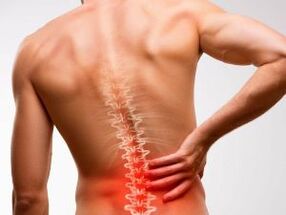
Lumbar osteochondrosis is a chronic pathology of a degenerative-dystrophic nature that affects the vertebrae and the discs separating them.The lower spine suffers more often than others, which is associated with its greatest load and mobility.
Thanks to upright walking, man became not only the pinnacle of evolution, but also acquired many problems.Due to the unnatural position of the body for a mammal, all the weight falls on the spine.Problems of the lumbosacral region are present in every third inhabitant of the planet.
The disease is diagnosed mainly in people of working age, although until recently it was considered to be the lot of the elderly.Today, osteochondrosis is detected even in young people, and at the age of 30-40 complications are already observed.
In recent years, many new methods for diagnosing and treating chondrosis have appeared, but its prevalence is steadily increasing.
What is osteochondrosis
Osteochondrosis of the lumbar spine (LOP) develops in almost all people who have reached a certain age, and is one of the processes of aging of the body.Over time, as well as under the influence of external and internal factors, the intervertebral discs lose moisture and become thinner.Injuries, systemic diseases and back overloads contribute to earlier development of pathology.
There are several theories of the occurrence of osteochondrosis: vascular, hormonal, infectious-allergic, traumatic, etc. But none of them explains the true cause of the changes occurring.
Most experts are confident that the trigger is a systematic overload of one or more spinal segments.This is not only hard physical labor associated with lifting and carrying heavy objects, but also features of the motor stereotype - one’s own manner of walking, standing and sitting.
Important: osteochondrosis of the lumbosacral spine is diagnosed more often in men than in women.
The load on all vertebral structures increases with poor posture, constant stay in an unphysiological, incorrect posture, or walking with a bent back.The situation can worsen with structural anomalies and nutritional deficiencies of the spine caused by heredity.
The first manifestations of osteochondrosis of the populaceae often occur at the moment or immediately after lifting heavy objects while working around the house or at the dacha.There is a scientific explanation for this: normally, the intervertebral disc can withstand heavy loads due to its elasticity due to sufficient moisture content.And liquid media are difficult to compress.A healthy disc can withstand external pressure weighing up to half a ton.With osteochondrosis, the volume of fluid decreases, and half of this weight is enough to damage the integrity of the disc.
The lumbar region can withstand a load of 200 kg when a person weighing 70 kg holds an object weighing about 15 kg in his hands, while his body is slightly tilted forward.If a person, holding the same load, bends even further, the force of pressure on the lumbar discs will increase to almost 490 kg.This is why complaints about a “stuck back” first arise precisely after physical effort.
Development mechanism
The intervertebral disc consists of the nucleus pulposus and the annulus fibrosus.With osteochondrosis, metabolic processes and blood supply are disrupted, and he does not receive enough nutrition.The disc gradually flattens, its elasticity decreases, and radial cracks appear along the edges of the ring.
Neighboring vertebrae begin to move closer together, disc tissues are destroyed, and the pathological process involves the spinal ligaments, muscles and capsules of the facet joints that “fasten” the spine.All this causes a reaction from the immune system and the development of non-infectious (aseptic) inflammation, in which the back tissues swell.
Due to changes in the position of the vertebrae, the joint capsules are stretched, and the thin intervertebral disc no longer secures the spinal motion segment so firmly.Thus, instability of the spine is formed, and the likelihood of pinched nerve roots increases.It is the compression of the spinal nerves that provokes pain in the lumbosacral region, which is often aggravated by compensatory muscle contraction.
Important: if osteochondrosis is not treated, a hernial protrusion will form - its most common complication.
In the later stages of osteochondrosis, bone tissue grows with the formation of growths on the vertebrae - osteophytes.They can also cause compression of the nerve roots and associated pain.
The spine suffers in the following situations:
- high loads on the spine;
- physical inactivity, sedentary work;
- unbalanced diet;
- frequent infectious diseases, hypothermia;
- poor posture, congenital and acquired vertebral deformities, scoliosis;
- autoimmune and allergic reactions;
- back and spine injuries.
Important: a significant factor in the onset and development of osteochondrosis is excess weight.The higher the body mass index, the more pronounced the changes in the spine are.
Symptoms
The leading sign of osteochondrosis is back pain of varying intensity (lumbago), which can radiate to the leg on the affected side (sciatica).At first it appears from time to time during sudden movements or high loads, then it becomes an almost constant companion of a person and bothers even when coughing and sneezing.
When a nerve is pinched, osteochondrosis manifests itself with sharp, shooting pain, stiffness of movement and other symptoms:
- sensitivity disorder in the legs, numbness;
- muscle weakness;
- decreased tendon reflexes;
- coldness and paleness of the skin on the legs;
- sweating disorder.
The back loses flexibility, and sharp pain occurs when trying to change position, bend over or turn.General symptoms such as insomnia, nervousness, and fatigue are possible.In severe cases, the function of the genitourinary system is impaired.
Lumbosacral osteochondrosis can manifest itself as coccydynia - damage to the coccyx, accompanied by severe pain in the coccyx and perineum.Patients often complain of urinary disorders: frequent urge, incontinence or urinary retention.Men sometimes face problems with erectile function.
Treatment
Therapy for osteochondrosis is always comprehensive and is aimed at slowing down the pathological process and eliminating its symptoms.There is no universal medicine or method that can cure day disease.
In the acute period, it is necessary to provide rest to the affected segment.If necessary, the patient is hospitalized, but bed rest for several days is often sufficient.A person should lie on a hard, level and elastic bed: to achieve these parameters, it is recommended to place a wooden board under the mattress.
Depending on the duration and nature of the disease, symptomatic treatment, surgery to remove intervertebral hernias and deformities, and restorative therapy - rehabilitation can be carried out.
Analgesics
First of all, pain is relieved with the help of non-steroidal anti-inflammatory drugs (NSAIDs) or analgesics.They are prescribed for the shortest possible course, since long-term use negatively affects the mucous membranes of the gastrointestinal tract.
One of the best is a drug that blocks the activity of inflammatory mediators and stimulates the production of natural analgesics - endorphin hormones.According to studies, the drug is superior to other NSAIDs in its anti-inflammatory effect, and its analgesic effect is comparable in strength to opioid analgesics.However, what is very important, it does not cause dependence or addiction.
It should be noted that the drugs in the oxicam series belong to the latest generation of drugs and are much less likely to cause side effects from the gastrointestinal tract, unlike the popular ones.Among the newest means that provide a pronounced reduction in pain after 5-7 days of use.
Important: severe pain, for which conventional pills do not help much, is relieved with novocaine blockades.The procedure is performed strictly in a hospital setting and relieves pain for at least several hours.
Muscle relaxants
Anti-inflammatory and analgesic therapy is supplemented with muscle relaxants to relax muscles.They help eliminate spasms and thereby increase the mobility of the spine.These muscle relaxant medications also act as sedatives and reduce the nervousness characteristic of patients with osteochondrosis.
Both the physical and moral state of the patient depends on the speed of pain relief.Timely elimination of pain prevents the formation of a vicious motor stereotype and pathological fixation of the spine, and prevents depression caused by constant pain.
Drugs that improve microcirculation
Circulatory disorders in osteochondrosis are associated with impaired innervation of blood vessels that undergo spasms.Prolonged spasm, in turn, causes a nutritional deficiency in the vertebral structures.
To restore circulation, drugs are used that have a pronounced vasodilating effect.It can be supplemented with products based on Lipoic acid, which have a beneficial effect on intracellular energy processes and improve the metabolism of nervous tissue, which is very important for osteochondrosis.
Sedatives
The long course of osteochondrosis can be complicated by various neuroses and anxiety disorders, which are provoked by pain and limitations associated with the disease.In such situations, taking sedatives (sedatives) helps improve the patient's state of mind.
Thanks to the course of treatment, the pain threshold and performance increase, and the strength to fight the disease appears.For osteochondrosis, it is preferable to use the latest generation of products.Unlike tricyclic antidepressants, they are much less likely to cause side effects.
Products for cartilage restoration
Chondroprotectors are the name given to drugs that restore and strengthen the cartilage tissue of the intervertebral discs.This is a relatively new direction in the treatment of osteochondrosis and joint pathologies.
A course of taking chondroprotectors helps improve spinal mobility and eliminate pain, and also slows down destructive processes in the discs.
Vitamin and mineral complexes
Vitamin D and calcium are especially important for spinal health, the lack of which is more common in older people.Taking pharmaceutical complexes activates the restoration of bone tissue, increases the strength and elasticity of the ligamentous-tendon apparatus of the back.They are especially useful for osteoporosis, which quite often accompanies osteochondrosis.
Surgery
Spinal surgeries for osteochondrosis are performed quite rarely; the indication for surgical treatment is, first of all, significant compression of the spinal cord.The intervention consists of removing intervertebral hernias, realigning the vertebrae and decompressing the spinal canal.
According to indications, microdiscectomy, puncture valorization or laser reconstruction of the disc, replacement of the damaged segment with a prosthesis (implant) is performed.All operations are reconstructive in nature and do not have any effect on the course of the pathological process itself.
In conclusion
Osteochondrosis is treated not only and not so much with medications.The main method of maintaining spinal health is dosed and adequate physical activity, a balanced diet with sufficient vitamins and minerals, and adherence to a work-rest regime.
During the rehabilitation period, patients may be prescribed skeletal traction (traction) of the spinal column, which helps increase the distance between the vertebrae.Thanks to such procedures, the intervertebral discs are straightened, their blood supply and nutrition are improved.
Physiotherapy procedures, which are carried out both in the acute phase to relieve pain and during recovery, have a good effect.All patients are prescribed physical therapy and massage.Water and mud therapy, swimming in the pool, water aerobics, contrast baths and showers are useful.